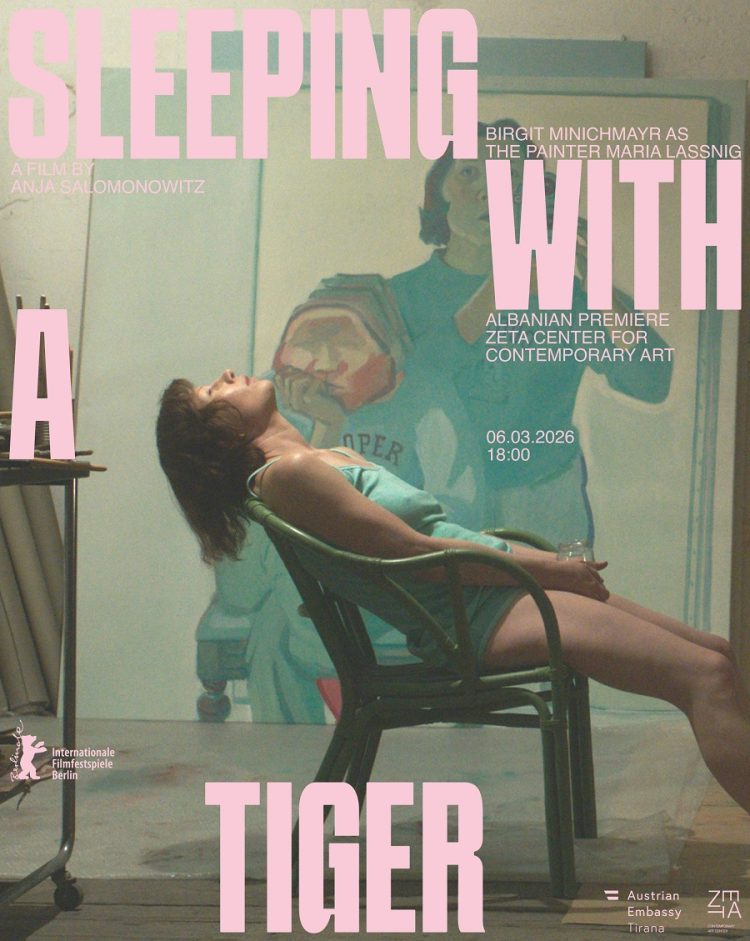
Albanian premiere of “Sleeping with a Tiger” — a film that is far more than a biographical portrait of Austrian painter Maria Lassnig; it is a cinematic homage.
06.03.2026
18:00
ZETA Contemporary Art Center
In this unique cinematic biography by Anja Salomonowitz, Birgit Minichmayr embodies Maria Lassnig at every age — 6, 19, 64, and 94 — moving through time as an eternally identical figure. The film translates the physical act of painting — “seeing and feeling the world from the inside out” — into a cinematic language, creating an intimate portrait of this exceptional artist.
This film is therefore no longer really a biopic. It is an evocative, picturesque vision of how memories and feelings are not anchored in time, but are able to evoke images at any time.
This premiere is made possible thanks to the generosity of the Austrian Embassy in Tirana.
Maria Lassnig once said, “I paint myself because I am the subject I know best.”
On the surface, that sentence sounds simple—almost modest—but there’s something a bit radical hiding in it. We’re always getting told who to be, what to want, what to feel. Lassnig ignored all that noise and started with herself, with what she actually knew. So, who was she?
Born in Austria in 1919, Lassnig spent her life chasing a single question: What does it really feel like to live inside your own skin? She never worried about making her art look exactly like someone. A headache wasn’t just a sort of displeasure to her—it was crazy red lines swirling around her head. Anxiety dragged her down, slumped her shoulders, made her heavy. But joy? That burst right out of her chest in a rush of color. She called what she did “body awareness painting” (Körpergefühlsmalerei)—art that begins deep inside and just pours out onto the canvas.
For years, almost nobody in the art world took her seriously. Why? She was a woman, and back then, men ran the show—and her art wasn’t cute or easy to sell. She didn’t care about trends or what the market wanted. She followed her gut. Through war, upheaval, and all the mess of twentieth-century Europe, she just kept painting, teaching, moving forward. When people finally started paying attention, it was because she never gave up. Her paintings are in major museums now, but her real legacy is refusing to let anyone else define her.
Now there’s this film: Sleeping with a Tiger, directed by Anja Salomonowitz. This isn’t your typical artist documentary. There’s only one actress—Birgit Minichmayr—playing Lassnig at every stage of her life: six, thirty, sixty, ninety-four. No disguises. No wigs or fake wrinkles. Just her, carrying all those years inside one body. It’s more than a gimmick. It gets at something real: deep down, we don’t really change. The stubborn, curious kid sticks around, hiding in there, even when we’re old and worn out. The whole thing’s kind of a strange blend. It’s documentary, but it slips into fiction, sometimes even feels like a dream.
Lassnig’s paintings aren’t just background—they almost seem to breathe. You hear snatches from her diary, old footage bleeds into new scenes. Time doesn’t behave; the story moves by feeling, not by the clock. The film doesn’t box Lassnig in or pretend to have all the answers. Instead, it invites you into her world for a bit. You feel her loneliness, her stubborn streak, and that quiet sense of winning just by sticking to who she is. The director doesn’t sugarcoat it either—he admits, “A biography is always just an interpretation; my film doesn’t claim to hold any truth.” That kind of honesty is rare. You get to meet Lassnig for yourself. But why does any of this matter here, now, in Tirana?
You don’t need to be Austrian to get it. Ever felt like you don’t quite fit in—like you’re too much, or not enough? That’s exactly what she captures in her art. The pressure. The feeling of being invisible. The guts it takes just to speak up and be yourself. In places where women artists still have to fight to get noticed—think Albania, Kosovo, all over the diaspora—her story really lands. For anyone living through change: Lassnig painted through wars, political chaos, cultural shifts. Albanian artists now wrestle with tangled histories—socialist realism, modernization, everything the world throws at them. The big question is still the same: how do you make honest art, not just what sells? Lassnig doesn’t hand out easy answers, but she shows what real integrity looks like. And for those whose bodies have become political—especially here in the Balkans, where bodies carry memory and resistance—Lassnig’s focus on inner experience, not just how things look, hits hard. She asks us to see our bodies as sources of knowledge, not just symbols.
For the ZETA community, this film just makes sense. It may lifts up young Albanian artists, and spark honest conversations right here in Tirana: What’s going on in your body right now? If you could paint that feeling, what would it look like? If you want, hang around after the film. No lectures, no fancy talk—just a chance to wonder together. Because the tiger isn’t just up on the screen or trapped in a painting. It’s right here, in the simple act of paying attention.