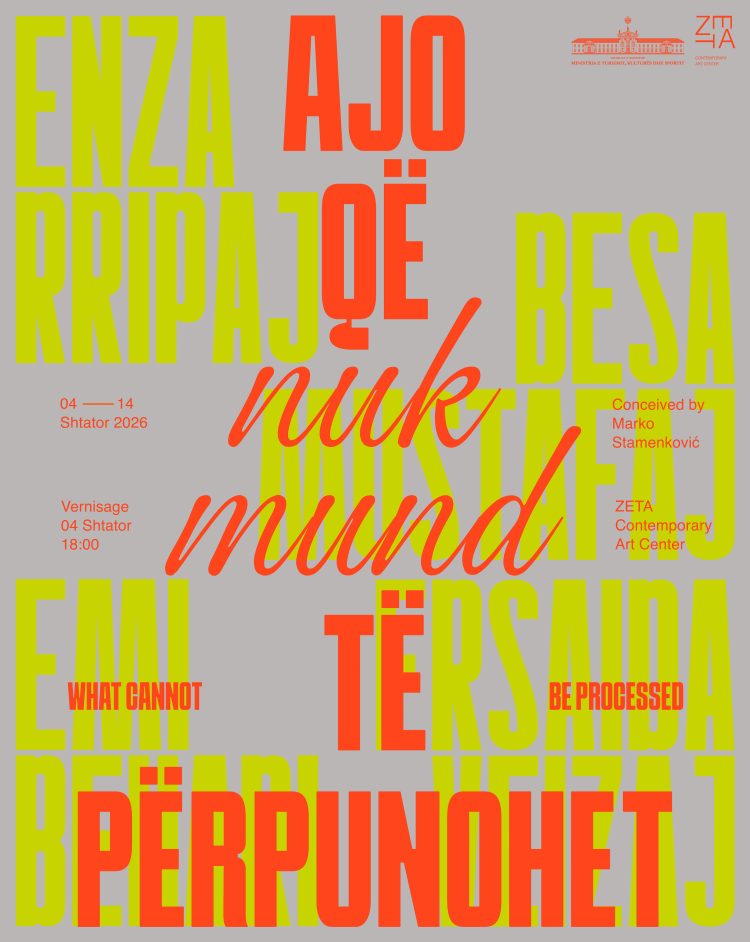
WHAT CANNOT BE PROCESSED
Conceived by Marko Stamenković
ZETA Contemporary Art Center
4–14 September
4 September
18:00
What forms of experience remain when nothing is measured—when life cannot simply be “converted” into data?
The exhibition WHAT CANNOT BE PROCESSED brings together four artists—Enza Rripaj, Besa Mustafaraj, Emi Behari, and Erisaida Veizaj—whose works engage with a contemporary condition of visibility in which the experience of reality—or, rather, of multiple parallel realities unfolding simultaneously—no longer guarantees understanding, while representation is no longer anchored in lived circumstances.
Instead, experience is increasingly mediated, translated, reproduced, and rendered operational.
The project was realized with the support of the Ministry of Tourism, Culture and Sport.
WHAT CANNOT BE PROCESSED
What happens when an experience (or its strategically enhanced misinterpretation) becomes ever more visible—as it does in the age of digital delirium—but cannot be genuinely or adequately translated and conveyed into information? Except for the deviated, metabolic form of self-sufficient communication in pursuit of strategic, calculative propaganda goals, no less imperial than “artificial” in its algorithmic power dynamics spanning media, continents and human behaviours nowadays?
When something that reacts naturally against the diabolic order of affairs finally refuses to succumb to the predetermined pragmatic visions of the “highest order of all” and, indeed, rejects becoming the matter of the past—how do you process the gesture of refusal? And the power of refusal itself: without images, without words, without Internet (the “spirit” of our times), if you will?
How do you process something, anything from the past and the present, that refuses to become or remain exclusively that: merely the “past” or the “present”? Raising your eyes above, towards the celestial screen, where do you find the actual remnants of potential Truth and Reason among all sorts of data embodied by stars, moonlight and noisy, curious and lethal “mosquitoes” overlooking everything and everyone below? Even before they leave their drone-factory nests to spread among us, the simple, worthless community of humans?
Try looking down at your feet, for instance, as humbly as you can, to start with the puzzle of un-processing: a footprint disappears wherever you pass, but the floor, the sand, the mud all retain its pressure. Or, in case you prefer attending a public protest instead, you must be aware that sooner or later the protest ends, with or without any expected historical U-turn or transformation. Yet it continues, no matter how invisibly and discreetly, to occupy the private sphere: YOUR private sphere—unless you stand firmly with those whose scepticism, justifiable enough, about today’s possibility for privacy (in an old-fashioned, “primitive” sense of the term) as utopian instantly classifies you into a category of people without mercy for allegedly emancipatory, “civilizing” attempts of artificially created realities to impose new power dynamics as the only actual answer to Truth, Reason and, why not, Faith. Yes, faith: in humans, semi-humans, and non-humans alike.
When one body is absent, yet traces of its presence remain; when an embrace can be seen, but never completely understood; when a figure, or a space of worship, of living, of working… can be reconstructed without ever being recovered – how do you process something that refuses to become visible, to announce or embody itself and be presented to others without having been converted into any legible system of signs (except for the initiated ones), without ever being properly described, pronounced or imaged?
We speak of processing in relation to personal experience as though experience were something that could eventually be sorted, understood and put away. But some things resist this passage. They remain lodged in surfaces, cracks, gestures, skins, memories, traumas and, certainly, images – both sacred and secular. They return, no matter when or why, yet they return in altered forms. They become symbols, fragments, sounds, repetitions, distortions, noises, broken mirrors, abstract adventures. They exist and persist. They refuse closure. They cannot be “processed” by one and only order. They are many and among us. They are powerful. They are ghosts; and spirits, too. Monstrous and beautiful at the same time.
For your viewing pleasure they matter nothing, you know… And you also know that you matter “so much” for their devouring pleasures of viewing everything and everyone, everywhere, anytime…
Welcome to WHAT CANNOT BE PROCESSED!
In the age of digital phantasies, which some rather provocatively look at through the omnipresent prism of naturally fake intelligence, this exhibition is nothing but another little lie. Under the given conditions of digital revolutions, a resolution that—“as a matter of fact”—nothing can be unprocessed today is perhaps as self-evident and unnecessary as it is demanding the recognition of another position. That nothing remains except for the resistance to any resolution of all-things-processed and every conclusion or final solution to all-things-processed.
WHAT CANNOT BE PROCESSED thus gathers four humble, simple, and simply humane positions around this resistance to resolution. Without pretension, force, and aggression (the three pillars of current global geopolitics), four women and their works transform traces, political experiences, intimate gestures and bodies into images and objects. But they do not promise that transformation will make them intelligible.
Instead, they expose the gap between experience and its representation, in a time-space capsule of ZETA Contemporary Art Centre in Tirana where resistance still seems to be more than just another word in the AI vocabulary of multiple words (and multiple worlds, realities, images) that mean little or, often, nothing but only “words”… Here, in the midst of a world of poor words, cheap images, and high ambitions, art is not necessarily a means of overcoming what has already happened. It can also be a way of remaining with what cannot yet—or perhaps cannot ever—be fully processed.
When you think of “processing,” what usually comes to your mind? Like any other word, this one can mean several things at once: emotionally processing an experience, politically processing violence, digitally processing data, materially processing traces, cognitively processing an image, verbally processing gossips, virtually processing goods and ideological promises for sale, or institutionally processing what does not fit an established category.
The four artworks on display seem to meet precisely at that point where multiple meanings of a single word cross each other: something has happened, something has been experienced or left behind, but it cannot be completely transformed into knowledge, representation, memory, language, or resolution. In other words,rather than treating art as a mechanism for turning experience into something complete, coherent, and intelligible, the exhibition approaches artistic practice as a space where things may remain unfinished, excessive, ambiguous, latent, or resistant to resolution.
Why not? If you need to have something complete or completed, including any sort of communication, you are free to ask your preferable AI assistant and you get a full package. Alternatively, instead of unleashing your creative prompt-engineering skills, you may choose to touch another surface with your own hands: by turning blank papers into a set of charcoal or pastel drawings, a piece of textile or a curtain into a vibrant watercolour painting, or a couple of patchworks into a disturbingly “alive” female figure—or a charming little monster coming out of the dark dust on the old floor straight into your computer screen…
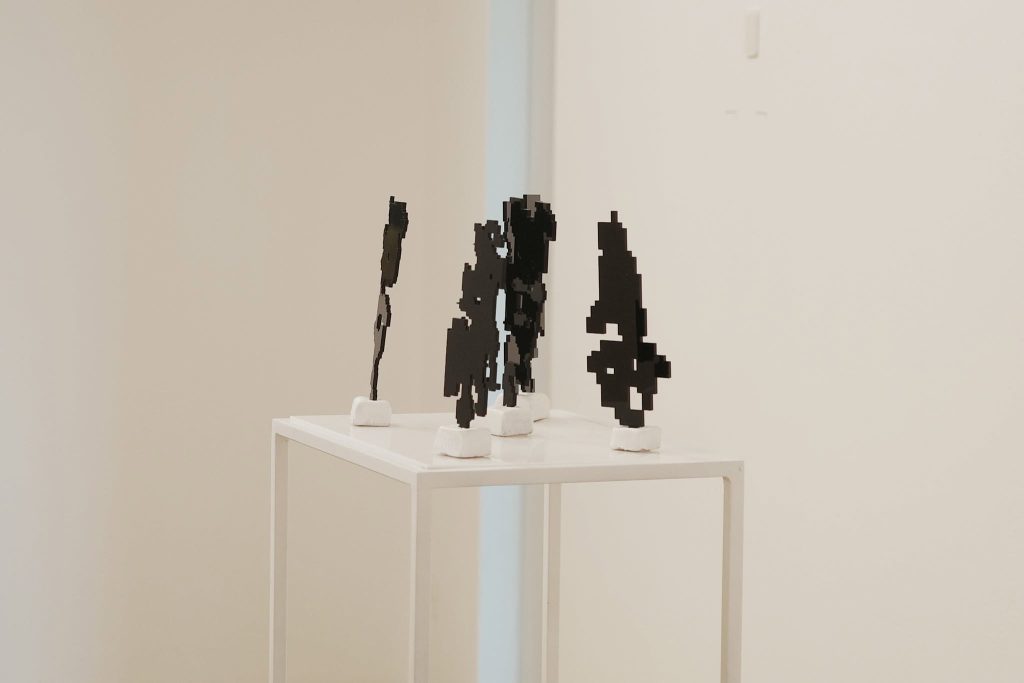
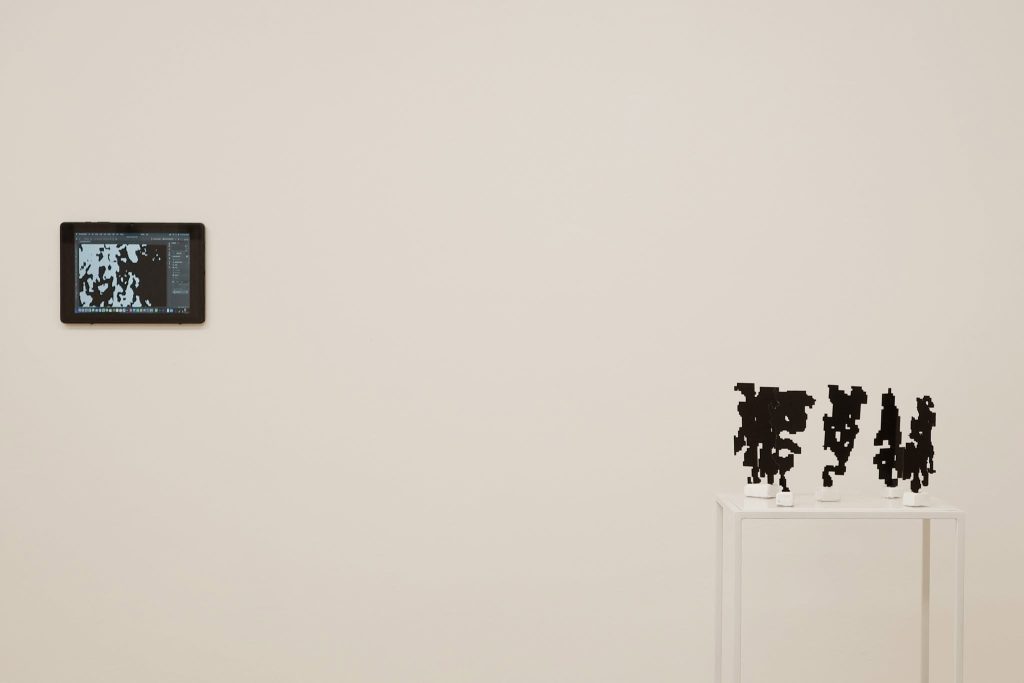
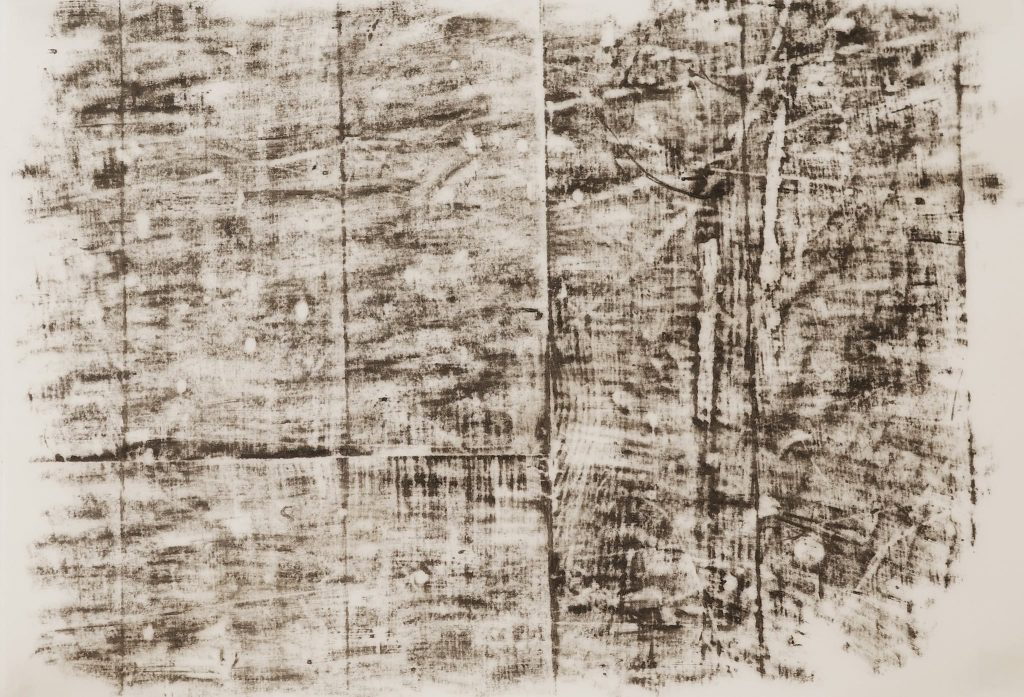
Enza Rripaj has developed a remarkably consistent conceptual practice that questions forms of attention that produce no output—and what might take place within them—as well as whether duration itself might constitute a form of resistance. In her Sub Super Facies (creatures of darkness IV), the question begins with the apparently inert surface of the gallery floor of ZETA Contemporary Art Centre – now in its twentieth year of operation. Continuously crossed by bodies, the floor accumulates scratches, pressure, dirt and wear—the material residues of countless presences that are no longer there. Through frottage, scanning and digital reconstruction, Rripaj moves from trace to image and from image to body. Yet what emerges is not an identifiable person but Her Majesty, an Anonymous.
The reconstructed figures are fictions generated from real material evidence. The work therefore occupies an unstable territory between archaeology and imagination, archive and projection, memory and pareidolia (feel free to ask your preferable and always ever trustful AI assistant for the definition of this magical word). The floor remembers, but only indirectly; the artist reconstructs, but cannot recover. What cannot be processed here is perhaps precisely the absent body itself: its disappearance cannot be reversed, only given provisional form. It is yours as much as anyone else’s (if you dare to look behind the curtain).
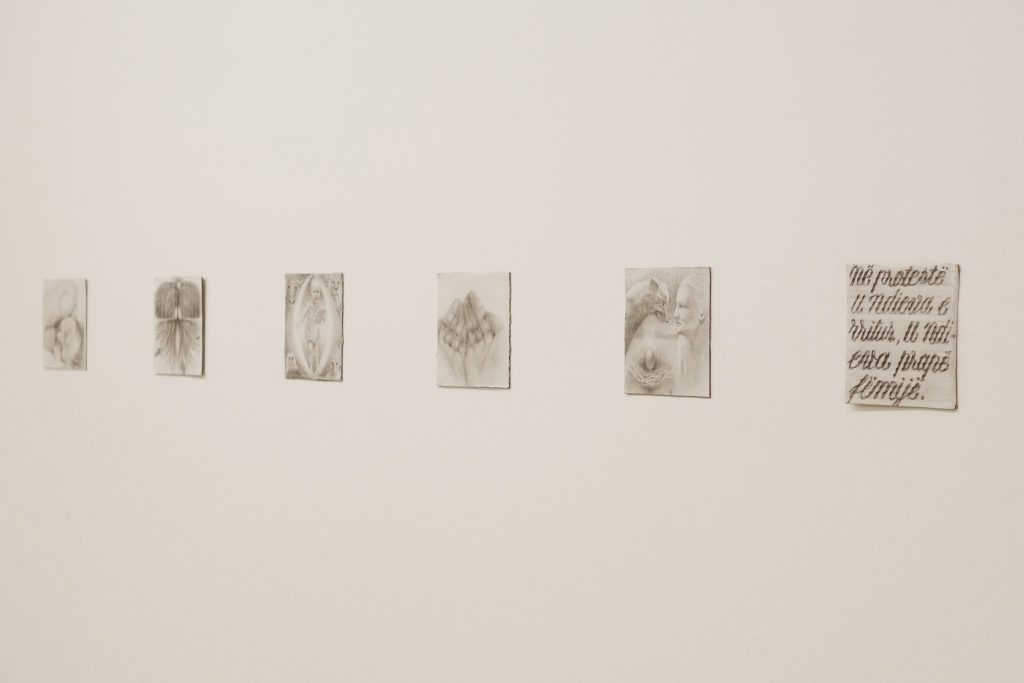
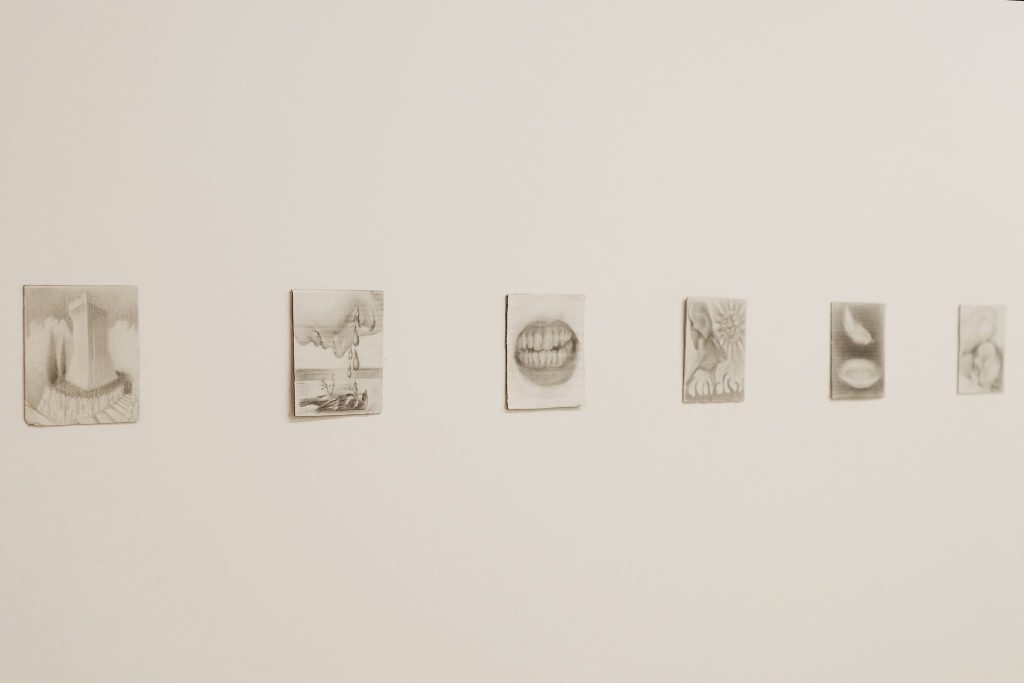
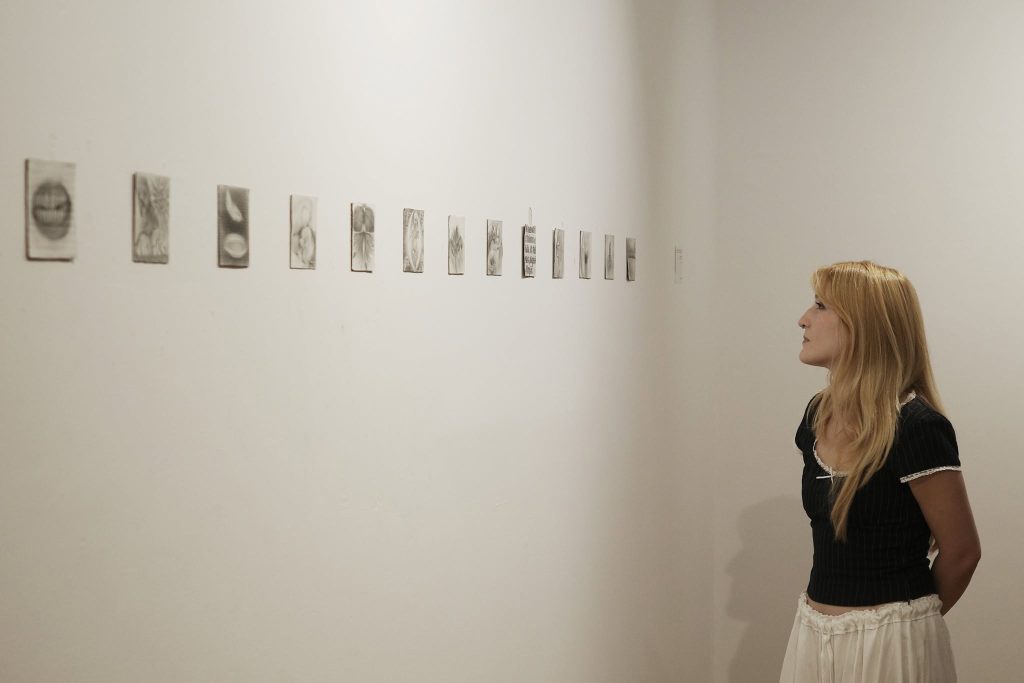
Emi Behari‘s drawings approach the problem from another direction. Here, what cannot be processed is not necessarily absent—it is too present. The 2026 Flamingo Revolution enters the intimate spaces of everyday life: sleep, friendship, love, family, food, childhood, the body, landscape.
The artist’s diary, neither verbal nor digital, becomes a site where political events and personal experience become impossible to separate. Anger, mourning, surveillance, care and hope, even something as private as one’s own pubic area, occupy the same visual field. Do not be ashamed—engage with them: these drawings do not resolve any alleged contradictions. They embrace them. And preserve them. Untouched by political or algorithmic greed, they are visualized thoughts and statements that refuse to be processed, classified and stored. Yet precisely because of this, the drawings become a form of processing, but also evidence of its limits—a diary in which experience is recorded precisely because it has not yet been fully metabolized.
The series moves repeatedly between vulnerability and resistance: a sleeping body marked by a national map; hands that offer care while simultaneously containing watching eyes; a threatened future held within the fragile form of an egg; a feather registering imperceptible political currents; a tower awaiting its inevitable disruption. Even the recurring symbols of childhood and nature become politically charged. The private cannot remain private; the political cannot remain outside the body.
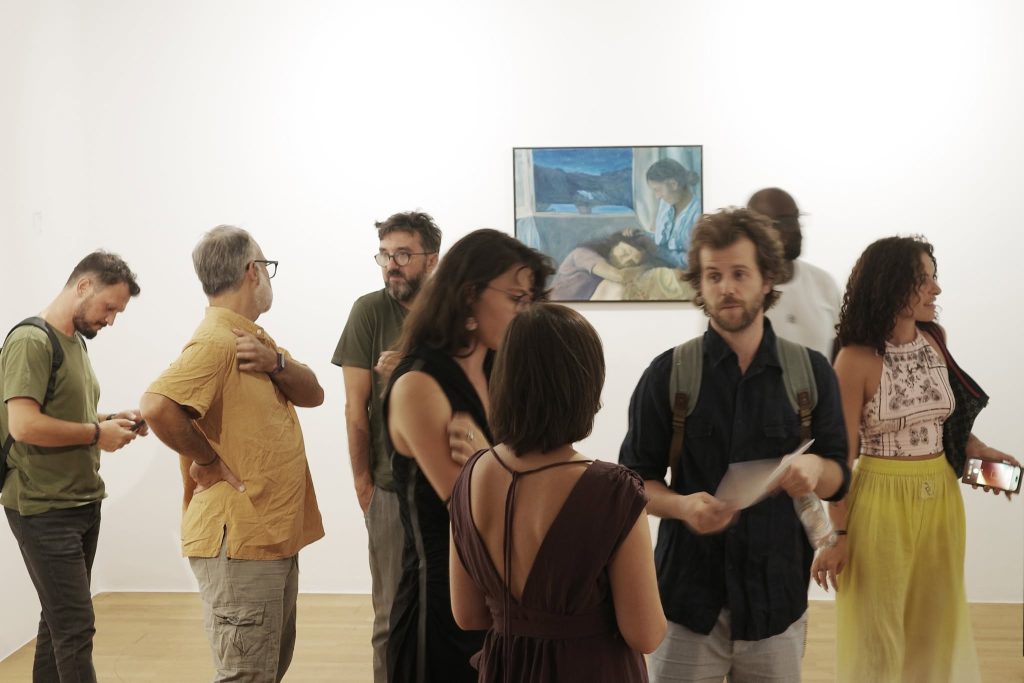
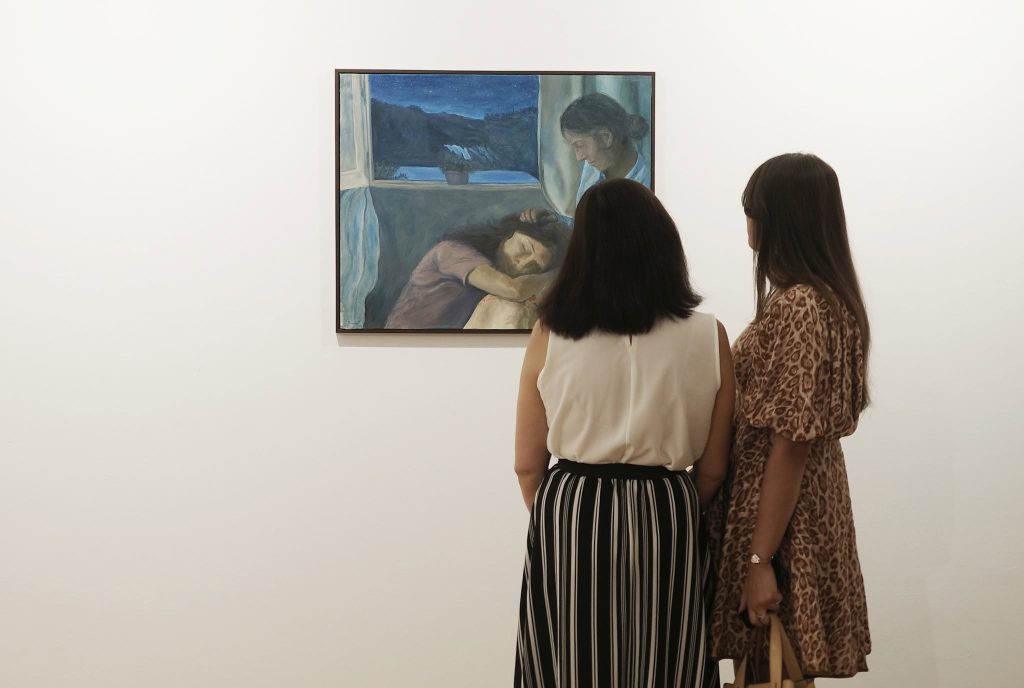
Erisaida Veizaj‘s image of the embrace (or hugging, if you prefer) is a response to the same kind of pressure, though by very different means and reasons. But it is also a kind of question unpronounced: What happens to (parental) sacrifice once it becomes visible? What remains after everything that can be measured, including intimacy (or its deliberate conversion into a public spectacle) has been measured, calculated, judged upon? Quiet, intimate and recognizably human, two bodies occupy a moment of profound physical proximity. One figure rests against the other, while the second remains present, almost watchfully, beside them. The scene appears simple, even familiar: a gesture of intimacy, exhaustion, protection or care. Yet the longer we look, the less easily the encounter can be reduced to a single meaning.
Is the person being held, cared for, protected—or simply sleeping? We don’t know. That uncertainty itself becomes productive. Also, what is being exchanged between these bodies cannot be fully seen. There is no measurable unit for the weight of trust, the duration of an embrace, the sensation of another body resting against one’s own. The image therefore holds something that remains outside the informational surface of the image itself: an experience that can be represented, but never completely transferred.
You feel it only when you give a hug to the other, even to your enemy. The experience it evokes is larger than any information, or misinformation.
So, what happens to this kind of experience (pleasant and dangerous alike) that cannot be processed, partially or entirely—when the body has disappeared, when there’s no one to hug? Or when the same experience cannot be remembered adequately, represented completely, and explained rationally?
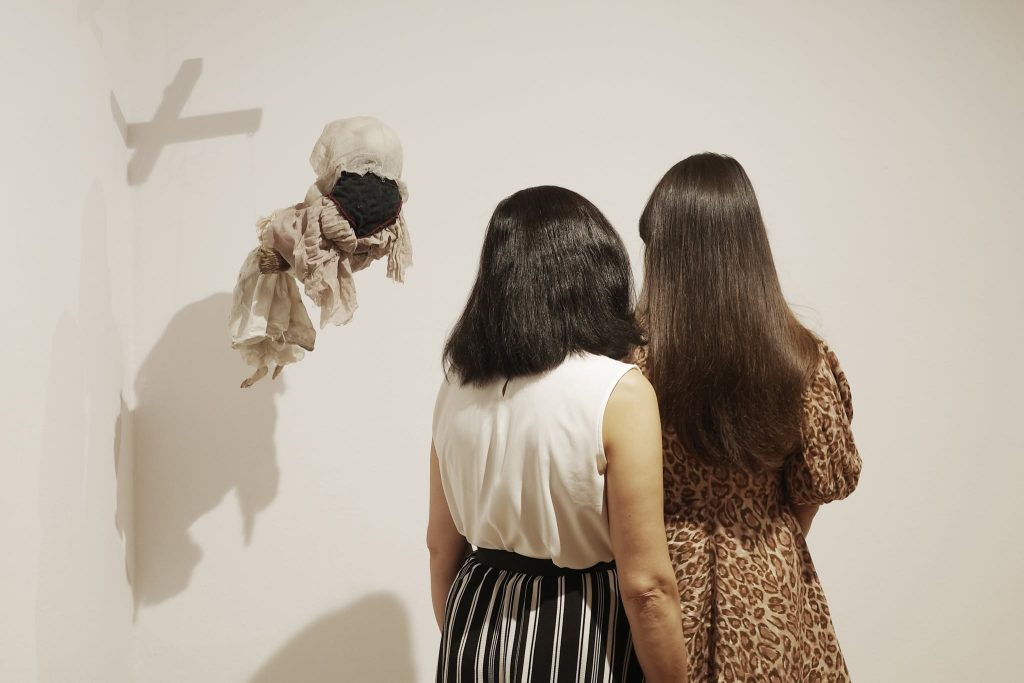
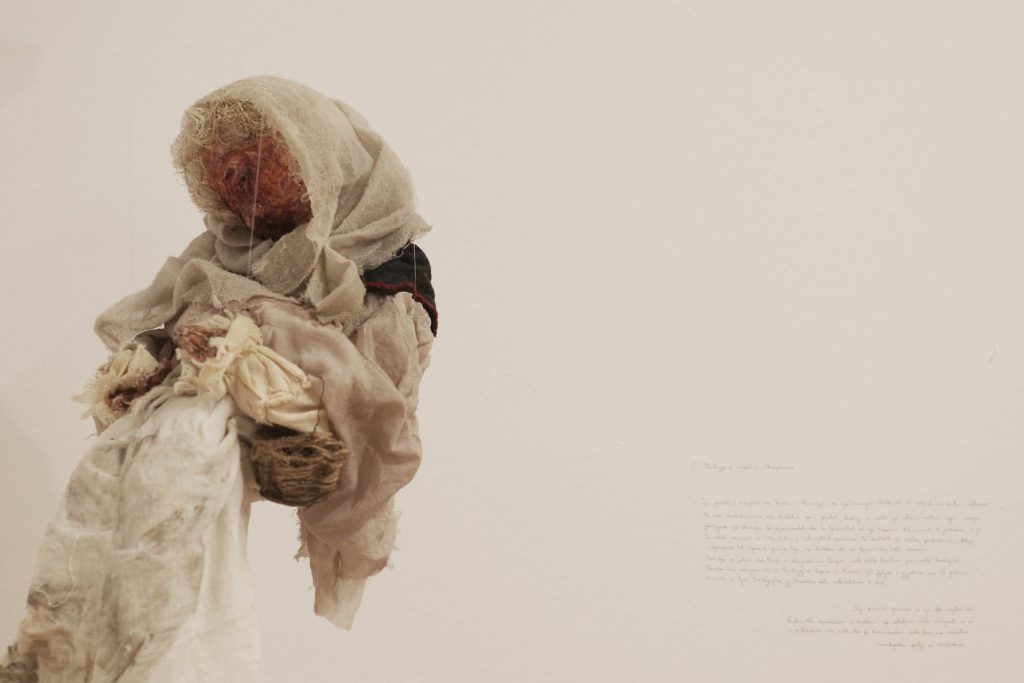
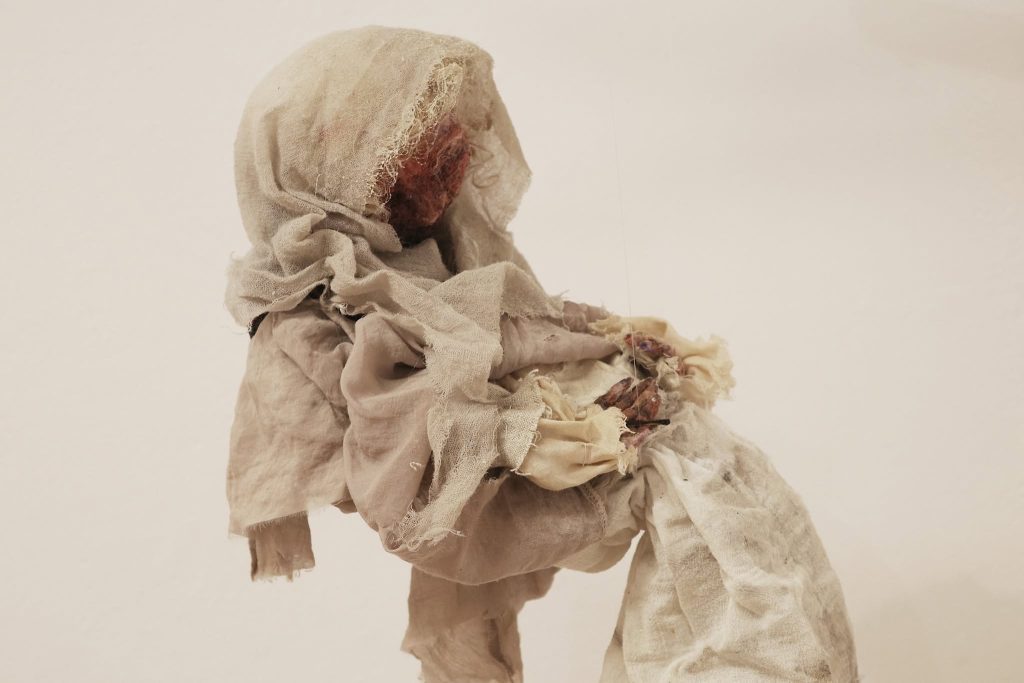
Besa Mustafaraj‘s object – strange, tactile, almost ritualistic and sacrificial – evokes some thoughts about these questions, yet without answers. Silence may be the most powerful voice ever to be processed, though not all the time and under all conditions.
This is what one preferable and always more trustful AI assistant (whose identity, for the sake of privacy and secrecy, cannot be disclosed) thinks about Besa Mustafaraj’s “silence”:
Her figure occupies an uncertain space between body, doll, relic and handmade object. Its fragile materials, visible construction and almost deteriorated appearance resist the polished legibility expected of contemporary images and objects. It resembles a body, but refuses to become a stable representation of one. Here, the material itself seems to carry a memory. Fabric, hair, fragments, surfaces and traces of making accumulate rather than resolve into a clearly identifiable identity. The figure cannot be easily classified: it is simultaneously familiar and uncanny, intimate and alien, human and artificial.
If contemporary systems ask us to identify, categorize and assign meaning to what we see, Mustafaraj’s object (you may call them “dolls”, but be aware of simple definitions and risks carried therein) seems to remain deliberately in excess of classification. It asks us to encounter something before we start thinking we know exactly what it is.
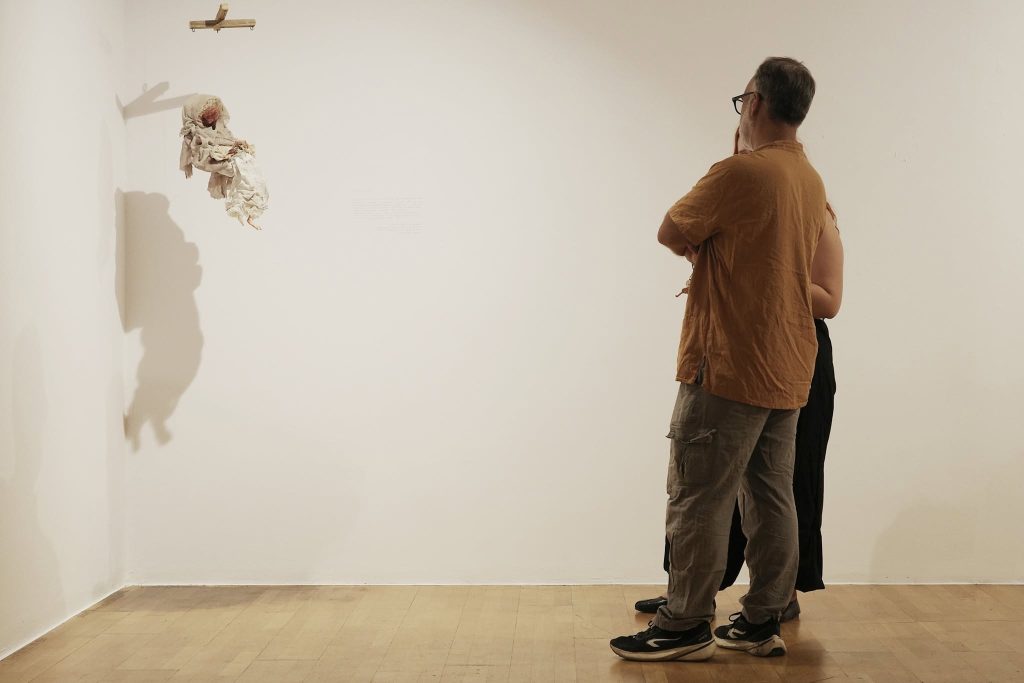
That connects very naturally to WHAT CANNOT BE PROCESSED. Can it ever be?
Marko Stamenkoviq