2025 Ardhje Award Exhibition
Curated by Vincent W.J. van Gerven Oei
With artists: Olsi Hoxha, Enza Rripaj, Bekim Hasaj and Dea Shubleka.
October 19, 2025 @ 18:30 – 21:00
@ZETA, Tiranë
2025 ARDHJE Award Winner will be announced during the opening of the exhibition, on October 19, 2025.
The international jury members are: Lindsey Berfond is an Assistant Curator and Studio Program Manager at the Queens Museum (RU), (USA); Alban Hajdinaj artist (AL) and Francesco Scasciamacchia is a curator and researcher working at the intersection of contemporary art, critical studies, and performance (IT).
The 2025 ARDHJE Award is supported by: The Trust for Mutual Understanding, Residency Unlimited, and the Young Visual Artists Awards.
The exhibition of the finalists of the Ardhje Award 2025 will remain open until November 10, 2025.
Jury’s motivation
First I want to say thank you and it was such a pleasure to meet the four wonderful exhibiting artists today and hear more about your practices. A big thank you to Zeta contemporary art center for having me as well.
I’m happy to share a little bit from the jury, which I had the pleasure of serving on today with Alban and Francesco. I’ll go artist by artist in the order we met with everyone:
Bekim Hasaj
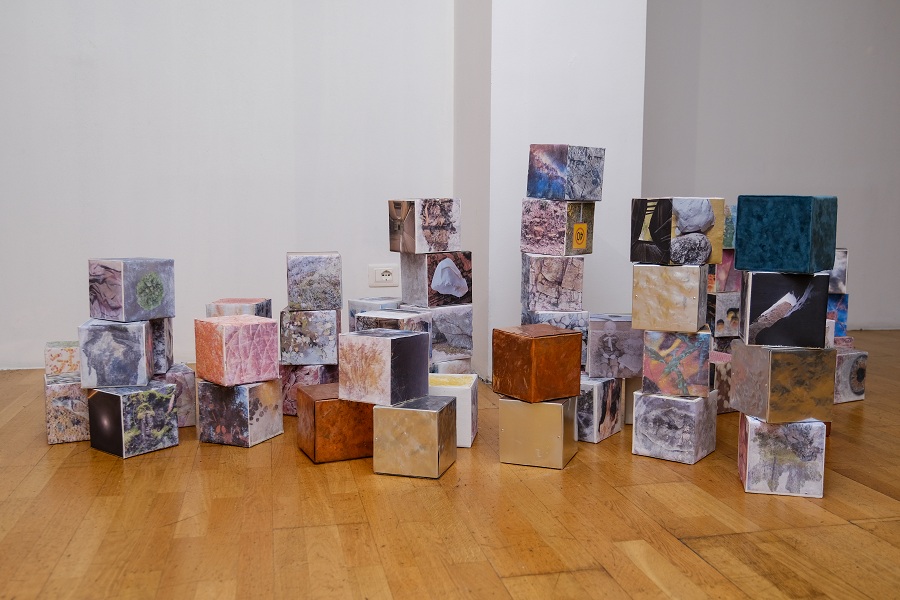
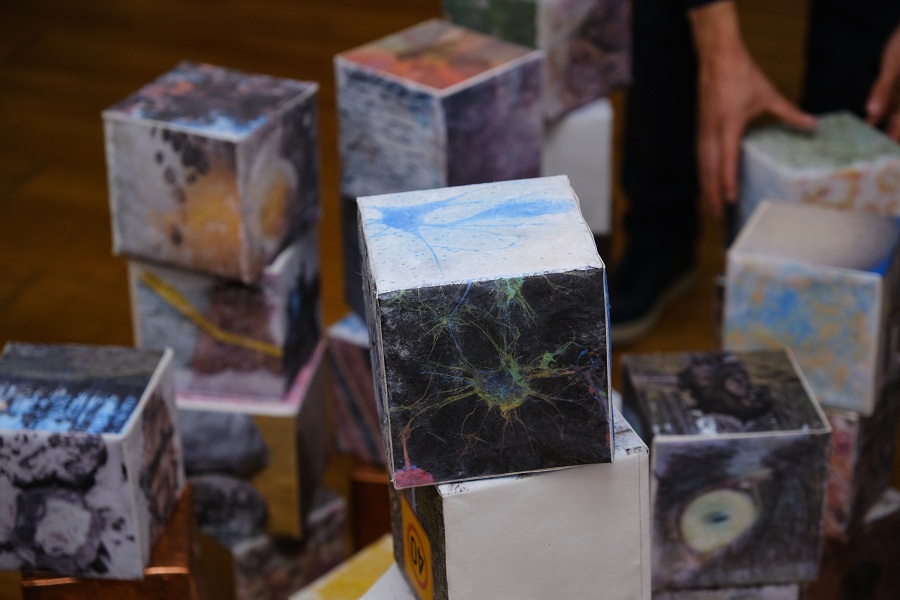
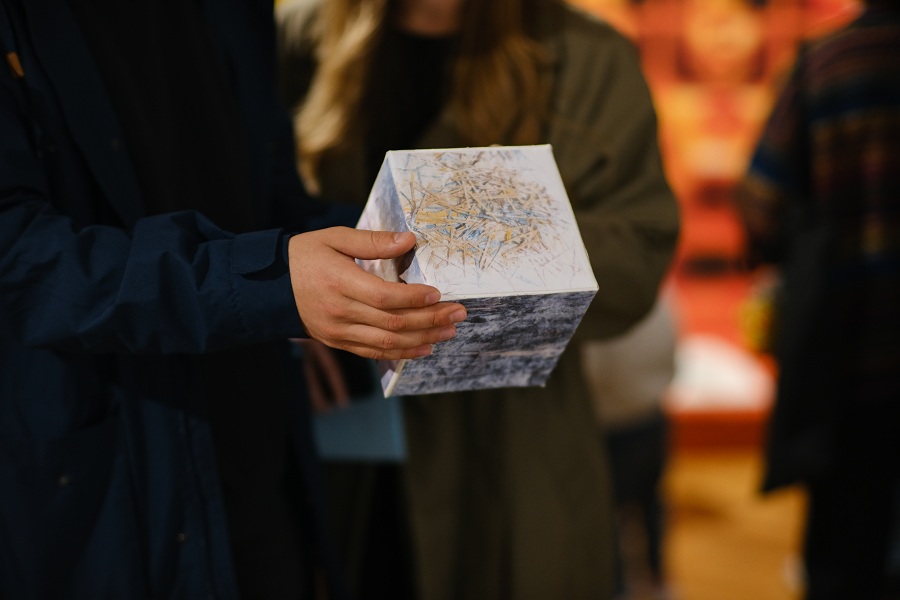
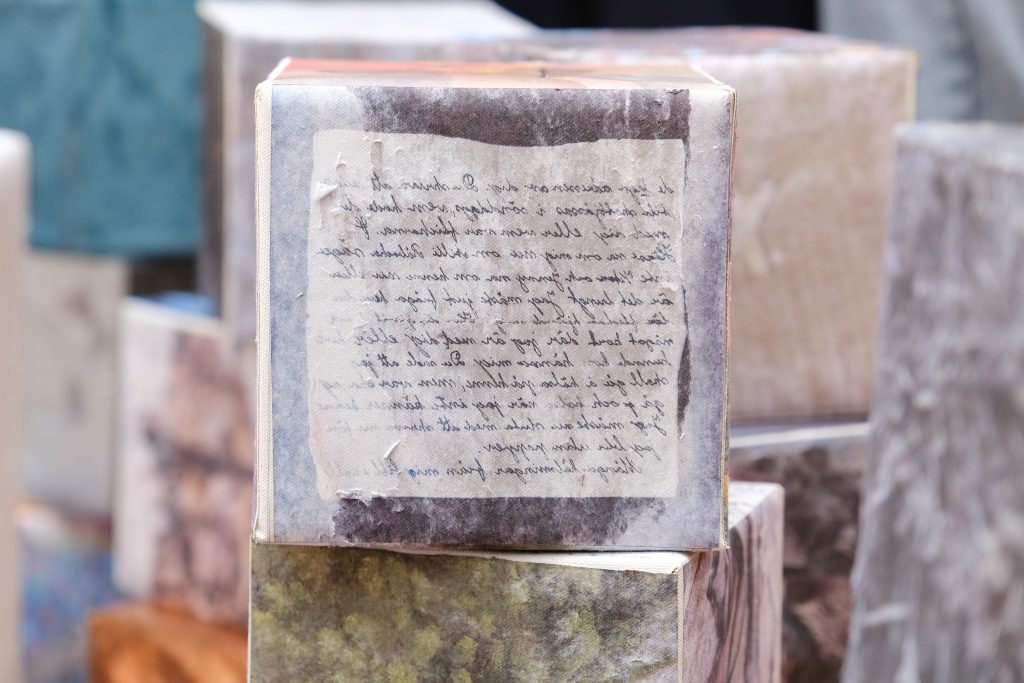
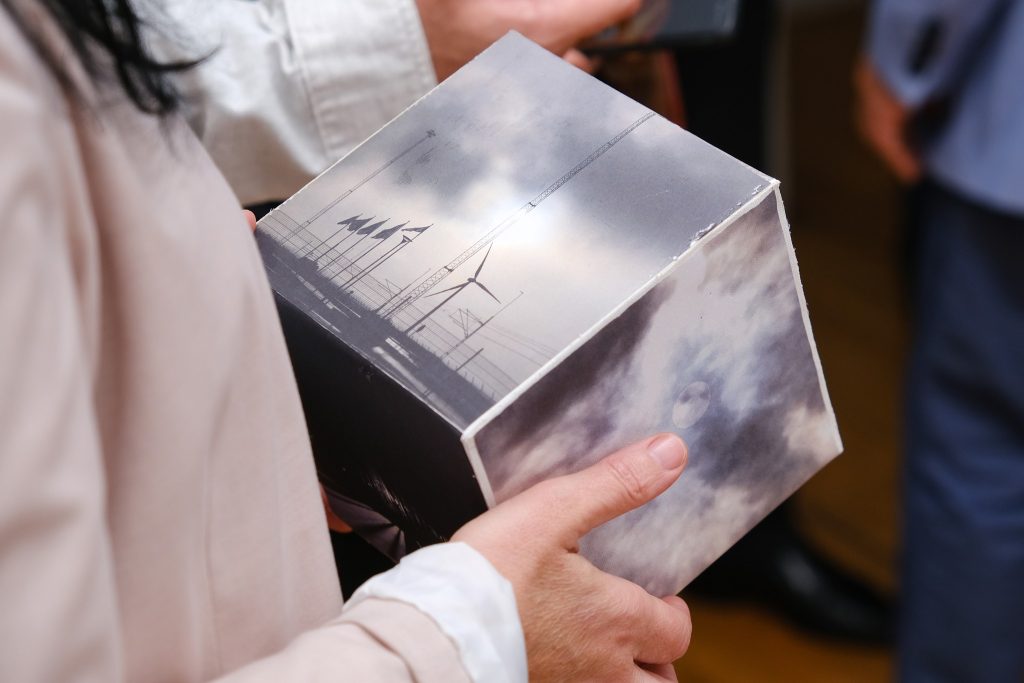
It was great to learn more about his diverse trajectory and evolution from working with painting in an expanded sense to moving towards sculpture and performance with a focus on color, form and surface. These all come together in his installation here that invites visitors to participate by creating infinite compositions or patterns with his image blocks. We found his experimentation between material object and image to be very strong, particularly the way in which he fuses photographs of landscapes and his own work to the canvas, working the material over and over until it becomes singular. We were also very interested in the part of his practice he’s refined in Finland, creating relationships with the natural world through creative intervention, like papermaking, and how these interventions can change our perception and connections to the land, which we found to be akin to land art.
Enza Rripaj
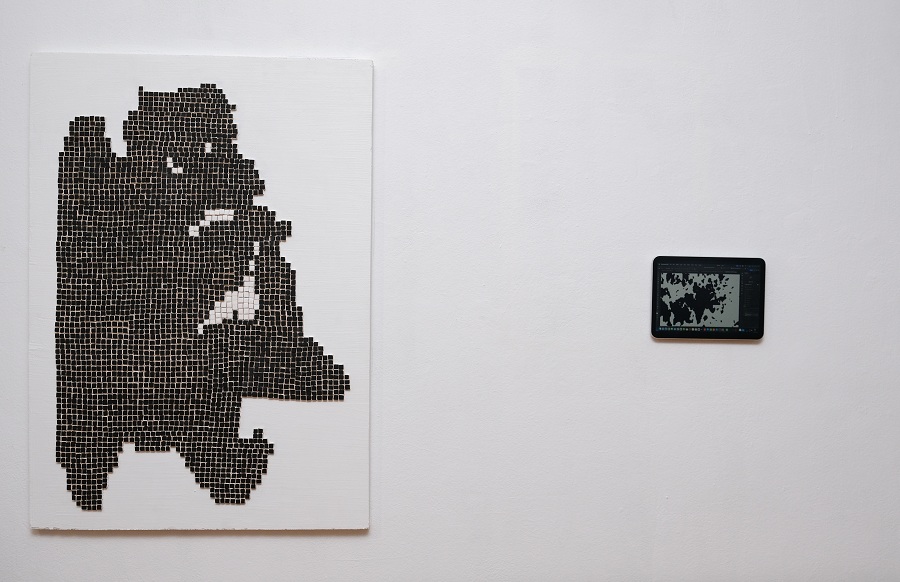
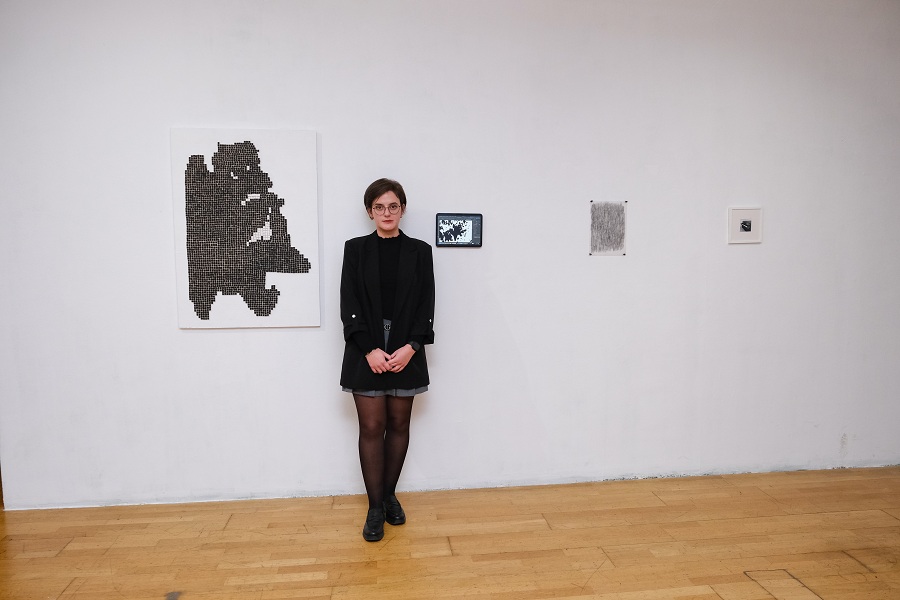
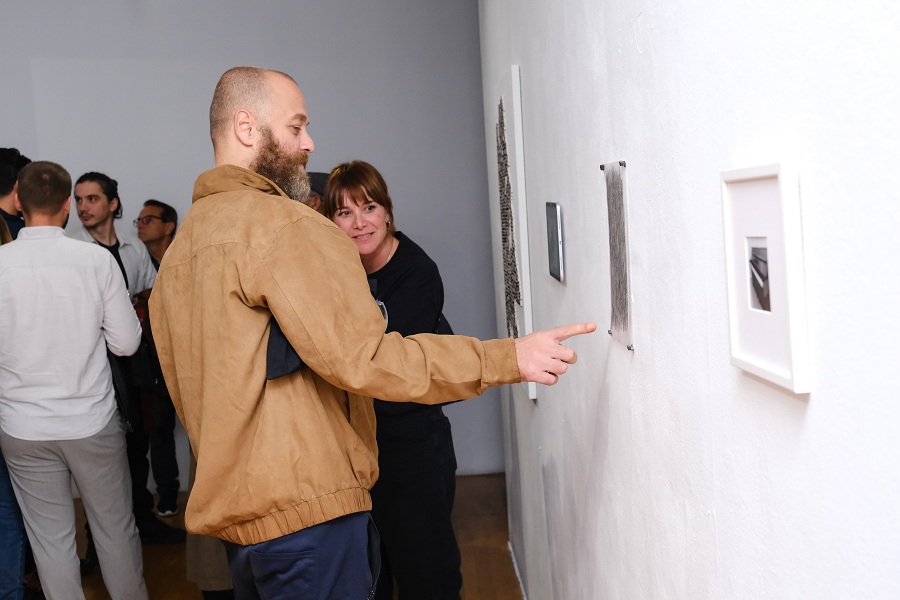
We found her approach to treating history as an abstract form to be very strong. She considers how the historical narratives function, but does so by moving away from the orthodox approach to history and instead looks closely at the traces of what is left behind to reveal new alternative perspectives. Through various unique systems she explores the memories and inner lives that objects hold. We found her use of the aesthetics of conceptual art and language to be exemplary. She invites the viewer to see what is often left unseen by the way history is traditionally written. In the same installation, Enza experiments and makes connections between a wide range of media from imprints or indexical drawings from the surface of the piano, to digital technology and pixel image data to handmade terracotta mosaic. We appreciated her consideration of time as a form for her works, as well as the metaphors of dark and light in her practice.
Dea Shubleka
We feel Dea’s examination of the space between purity and defilement to be very strong, as she demonstrated a well-considered relationship between the object and the sense of self within her work. We were very interested in how the body and intimacy functioned in her work as well as the spiritual sensibility of her installation which functions also a temple or monument. We were also drawn to the imaginary characters she’s created from childhood memories, hand-sewn and stuffed to look like oversized children’s toys. We thought these sculptures were very strong, evocative and psychologically charged. The way Dea publicly depicts rituals and personal narratives that are often only seen behind closed doors in private recalls the feminist motto “the personal is political” and the power of that statement especially in our current political climate. It’s clear to the jury that that she has a natural instinct for making work that is physically impactful but also visceral and transgressive.
Olsi Hoxha
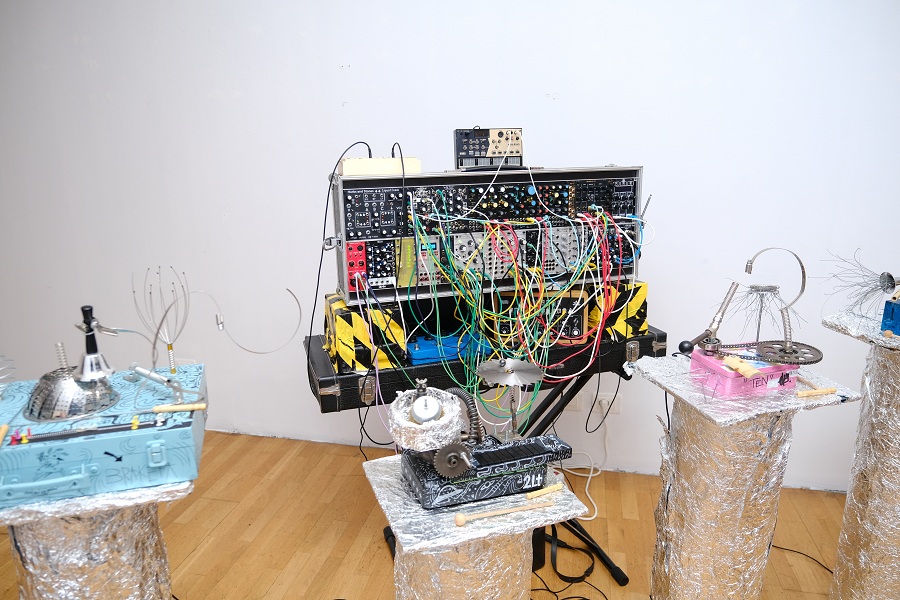
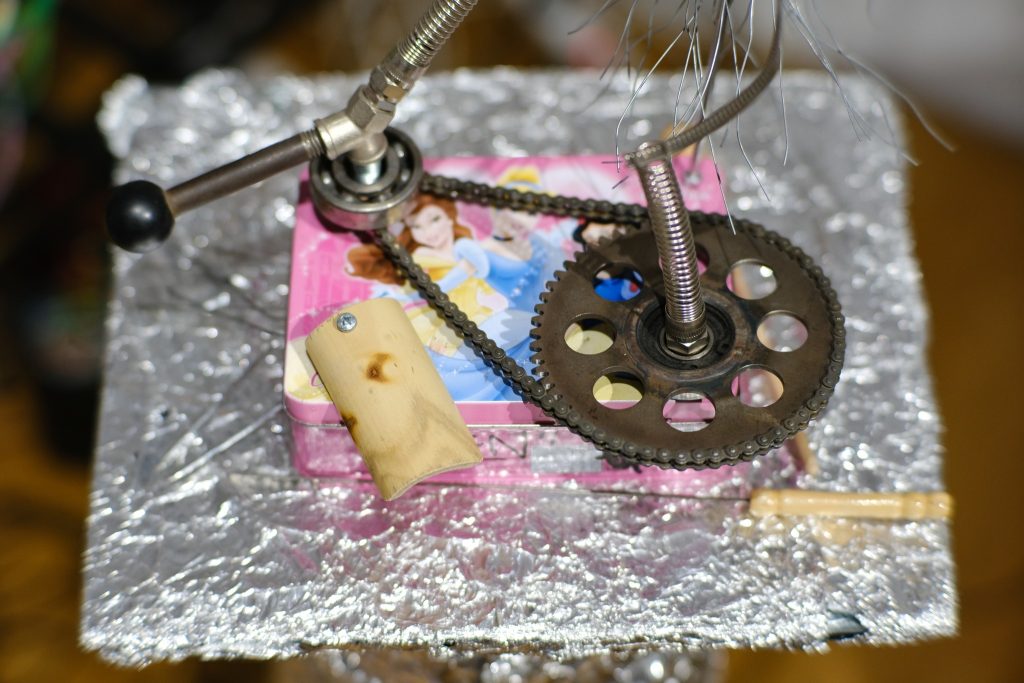
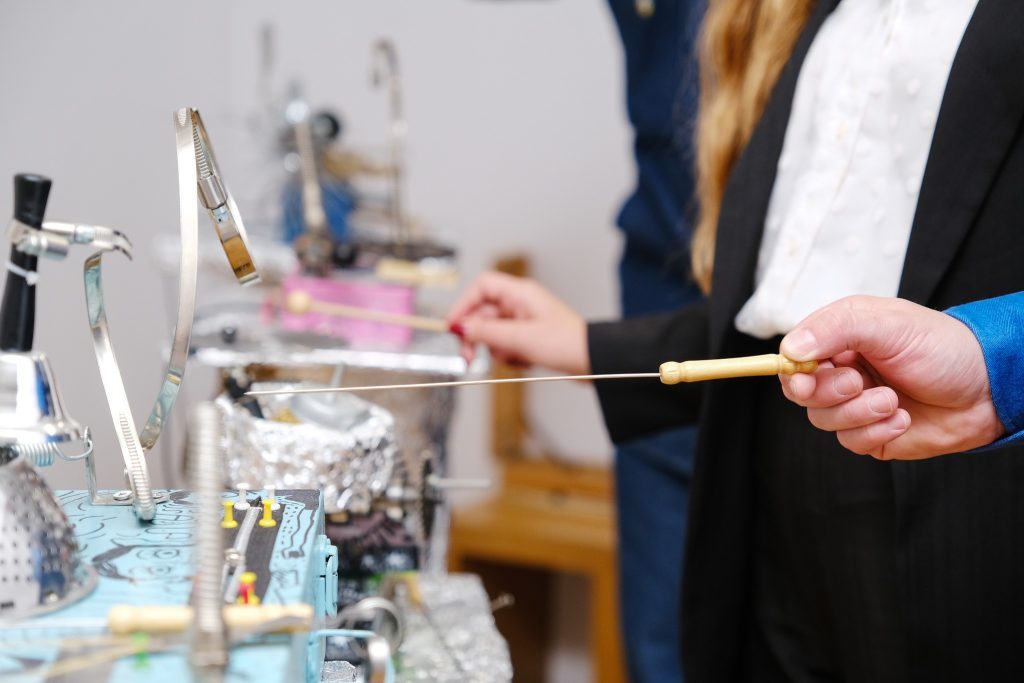
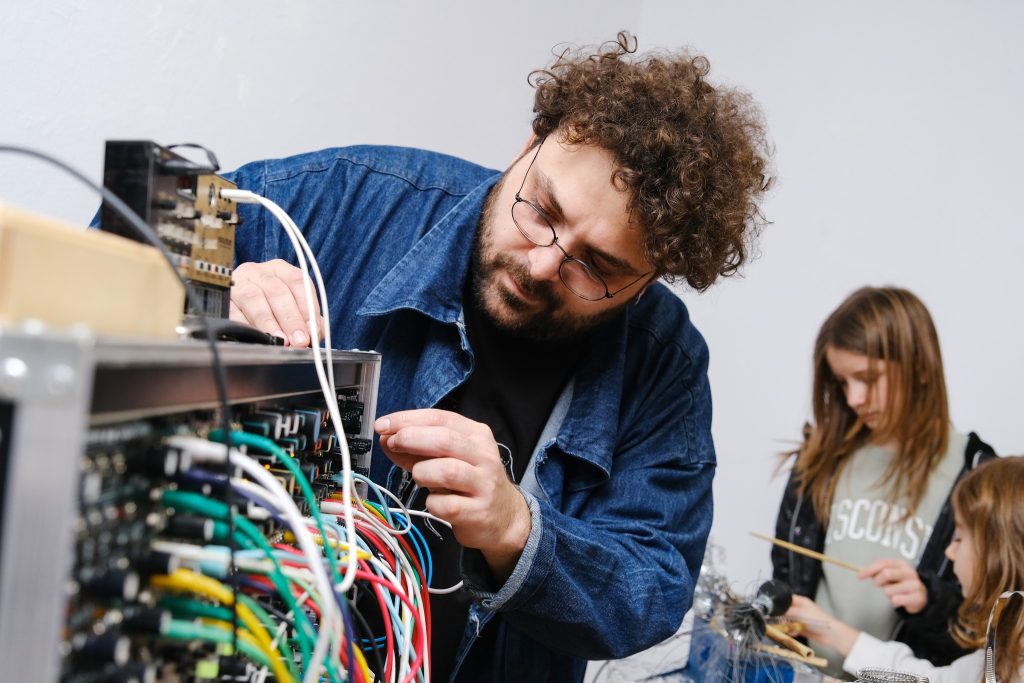
We thought Olsi demonstrated a solid research based practice that is coupled with an original aesthetic in his participatory sound installation. We appreciated the strong currency of knowledge he has developed around chaos theory, cybernetics, and theories of noise. Olsi uses analog electronics to repurpose salvaged found objects that have been cast aside or disposed of. He gives them a second life as electro acoustic sculptures that are activated in exciting and unexpected ways. In our time of artificial intelligence and algorithmic systems, finding new models of making with these electronics that can be intervened in and altered for a different purpose felt particularly important. We also felt that the concepts of uncertainty that guide Olsi’s work and soundscape to be timely in this moment, interrupting systems in unpredictable ways. The jury was interested in the importance of the butterfly effect in this body of work -or the role of small actions that can have a large resonance elsewhere – a concept which we felt is crucial as a counterweight living under systems of political oppression. We found his interest in tech from the 1990s to have a strong connection to the transitional moment of massive change here in Albania after the collapse of the communist regime.
We think he could benefit tremendously from meeting with artists in the sound art, experimental music, and creative technology scene in New York City.
And with that, on behalf of myself and jury members Francesco and Alban, we’re happy to announce Olsi as the winner of the award and residency in New York.
Introduction by the Curator
In collaboration with Residency Unlimited and The Trust for Mutual Understanding in New York, ZETA Center for Contemporary Art organizes each year the Ardhje Award for Albanian artists under 35 years. Held since 2007, the Ardhje Award provides its laureate with a fully funded two-month residency in New York. The Ardhje Award is part of the Young Visual Artists Awards network, comprising art awards in Eastern and Southeastern Europe, and gives emerging artists the opportunity to present new work to the public in an exhibition in the oldest independent art space in Tirana.
Each year, four finalists are selected who are given a stipend to produce new work to be presented, with the assistance of a local curator, at a group exhibition, where their work is evaluated by an independent jury comprising gallerists, curators, and other participating members of the Young Visual Artists Awards network.
This year’s finalists are Bekim Hasaj, Olsi Hoxha, Enza Rripaj, and Dea Shubleka. Even though each of their works operates in a different medium and comes from a distinct conceptual world, they are unified in addressing a question that continues to haunt Albanian society, namely “What does it mean to be a group?” With the collapse of the communist regime in the early 1990s and the implementation of a neoliberal shock doctrine that continues to resonate with the current government, Albanian society has insistently faced the problem of collectivity: How to be together without becoming an autocracy? How can we form groups without enforced conformity? How do we retain our individuality while also caring for communal welfare? That this question of the relation between the individual and the group persists also for a new generation of Albanian artists is apparent in the works presented at the 2025 Ardhje Award exhibition.
Bekim Hasaj’s installation Every Image Is a Pattern, Everything Is Abstract distributes previous works onto a variable three-dimensional surface, a fragmentation of works in colors, textures, and motifs that undoes the unity of his oeuvre and allows for its radical reorganization in the hands of others. Similar fragmentation is also evidenced in Enza Rripaj’s Sub Super Facies, which scours the surface of Albanian composer Prenk Jakova’s piano, zooming in on the traces left on it, the memories of the object itself, individuating them into terracotta pixels. Dea Shubleka’s installation The Yellow Turn heaves even closer to the person, as she cuts up her morning routine into dozens of photographic stills, fragmenting the self. It is not difficult to discern in all these works the logic of the grid, imposed by ubiquitous social media on our lives, forcing the constant separation not only of every experience, but also of our social relations.
But while these works address the separation and division of our lives, works, and memories, they also provide possible avenues to rethink this fragmentation as a whole. Olsi Hoxha’s interactive sound installation Source of Uncertainty invites the visitor to share in its creation of new sonic worlds, where each of the interactive sound sculptures contributes to the shared soundscape and each human becomes part of a human–machine cybernetic system. Similarly, Hasaj’s work invites the visitor to collaborate on the reconstitution of his work by rearranging the blocks, turning the gallery space into a collective playground. This idea of play as counterweight to fragmentation is also evident in Shubleka’s installation, where large fabric dolls observe and cushion the split-up artist, or in the very subject of Rripaj’s visual investigation: a musical instrument used to compose the quintessential Gesamtkunstwerk, the opera.
Play, the works in this year’s Ardhje Award exhibition suggest, may be the answer to the question the group insistently poses: how to be together without losing one’s identity; how to be group members and individuals at the same time. But let us remember that play can be a competition too!
The Question of the Group
2025 Ardhje Award Exhibition
Curated by Vincent W.J. van Gerven Oei
Olsi Hoxha (Tiranë, 1990)
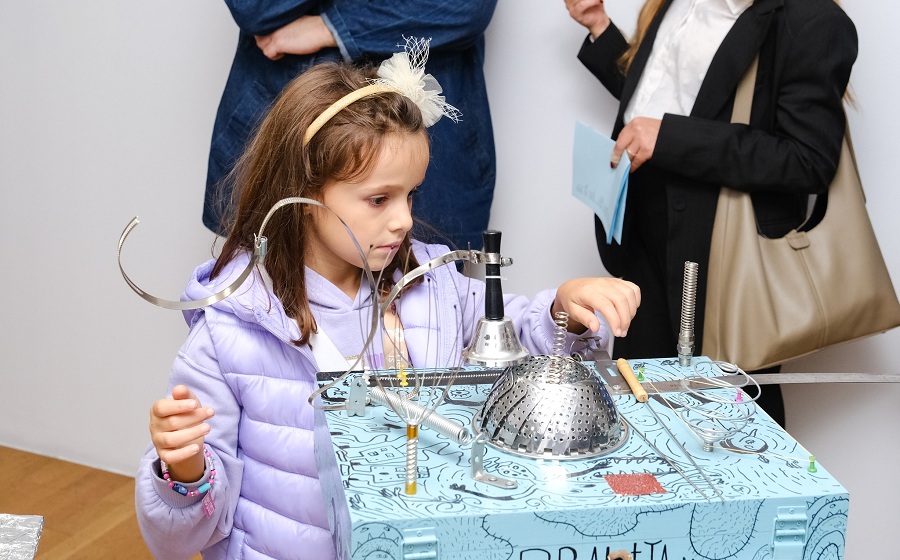
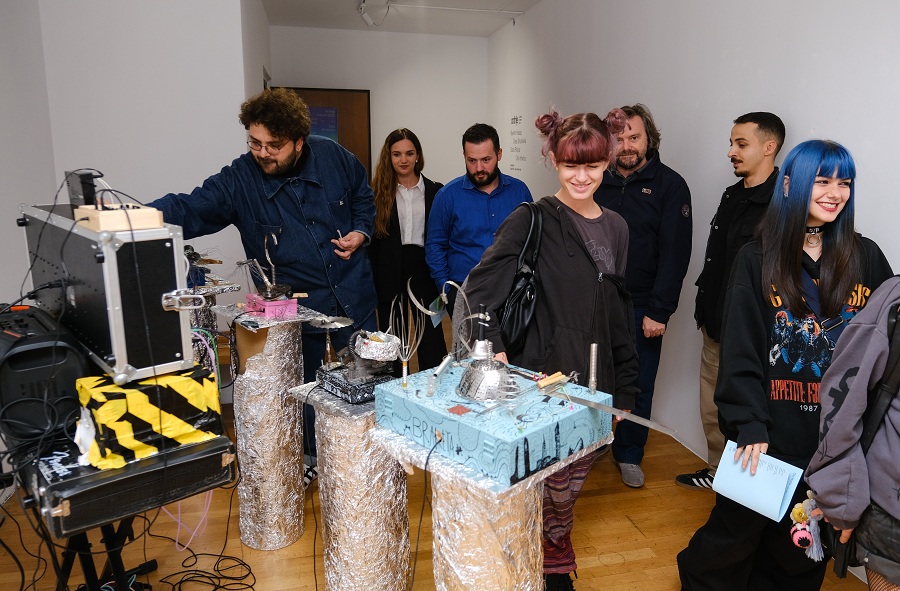
Source of Uncertainty (2025)
Interactive sound installation: Braketa (41x27x110 cm); Ten (29x41x95 cm); Main Modular System (93x16x150 cm); 2LT (33x22x91 cm); Sumce (60x22x100 cm)
Source of Uncertainty is a complex, expandable, and interactive system conceived as a site-specific project. adaptable to the place, situation, and context. It can evolve by growing in the number of individual works or be represented through a single piece. It is a living system, constantly in flux, investigating how order can emerge from disorder and how simple systems can evolve into complex, unpredictable behaviors.
The project is conceptually driven by two principles, chaos theory and cybernetics. In this context, every system becomes defined by the feedback it produces. The core of the installation is a series of electroacoustic sound sculptures, built through upcycling discarded or unwanted materials, objects that people have thrown away or no longer desire.
Each sculpture functions as an event generator, capturing resonance through piezo microphones. When activated, hit, scratched, or played by visitors, they produce sound and interact with the internal chaotic oscillators, modulating their behavior. In this way, the audience doesn’t just trigger the sound, they become part of the system, shaping its state in real time.
Enza Rripaj (Shkodër, 1995)
Sub Super Facies (2025)
Installation of photo (7×7 cm); tracing paper (21×30 cm); iPad (24×18 cm); terracotta mosaic (100×70 cm)
Creatures of Darkness is a series of works generated through frottage, the technique of rubbing tracing paper over a textured surface to capture its imprint. These imprints are then scanned and magnified to the point where pixels form abstract, fluid and dark shapes. In this way, pixels become narrators of an abstract geography, and simultaneously, a means to observe how physical materials and technology merge to construct a new visual language. The entire process unfolds as a narrative in itself, both horizontally and vertically, culminating in the status of an icon represented in mosaic form.
The imprints of Sub Super Facies were taken from the piano of the Albanian composer Prenk Jakova (June 27, 1917–September 19, 1969), the piano he used from 1964 to 1968, during which time he composed his second opera, Gjergj Kastrioti Skanderbeu.
Bekim Hasaj (Bajram Curri, 1990)
Every Image Is a Pattern, Everything Is Abstract (2025)
Canvas on cardboard, aluminium, and copper (variable dimensions)
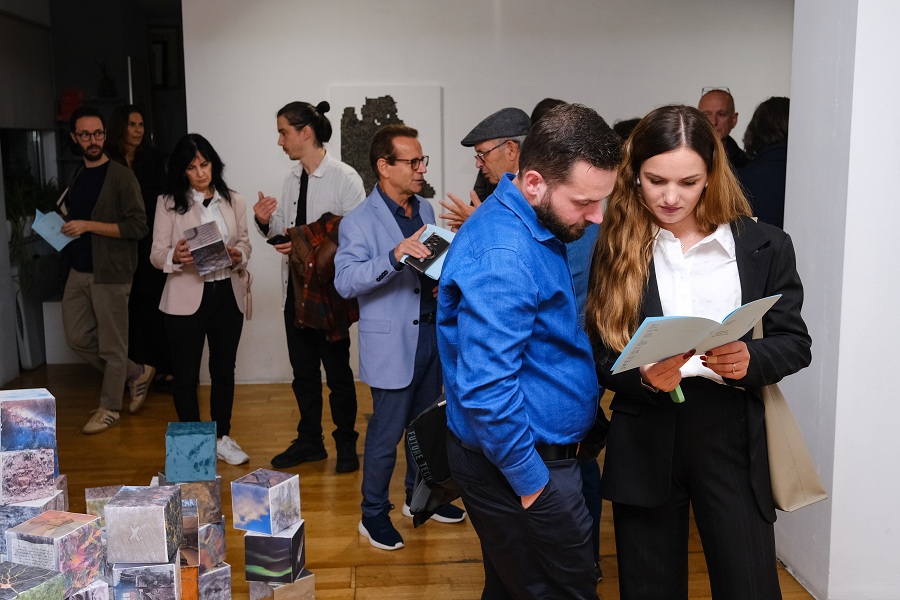
My pictures, presented in random order, invite the viewer’s response. In an allegorical way, they are welcomed to enter my house of images. As their host, I make them feel at home by showing this set of visual cubes, and in response, I accept their choices as an answer.
Their choices to act and change the disposition of these images, but also their reflective thinking scattered by them.
What is an image? How does it represent an object, a thing?! Is it real, original, and authentic to the objects it represents? What happens when this set of 1800 images is put together? Do they, as a whole, convey something to the viewer? What if the order of cubes is changed again and again? Do you see it as a figure, a shape, a movement, or as an abstract image? What lies underneath the singular appearance? Do you see a pattern? Tell me about it? I genuinely don’t know…
Dea Shubleka (Peshkopi, 1998)
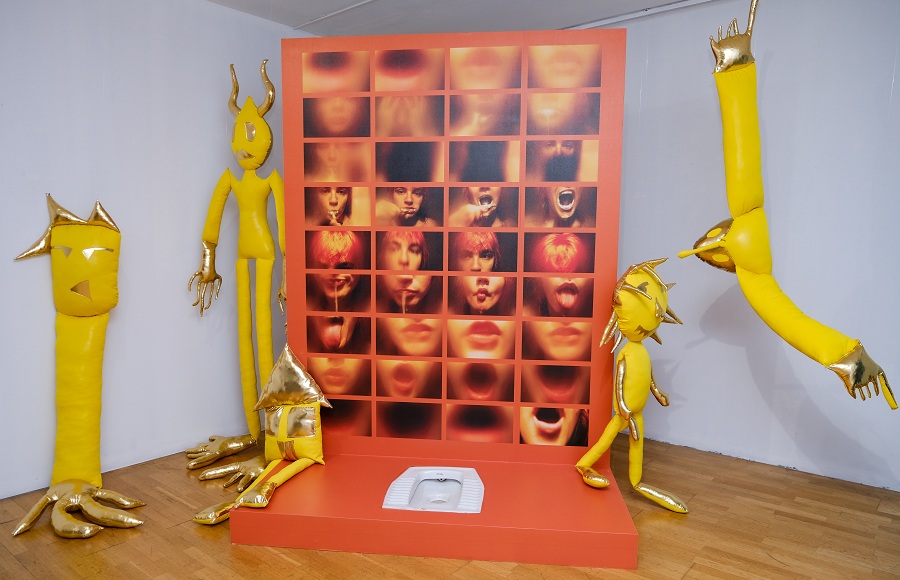
The Yellow Turn (2025)
Sculpture (170x90x230 cm), fabric figures (variable dimensions)
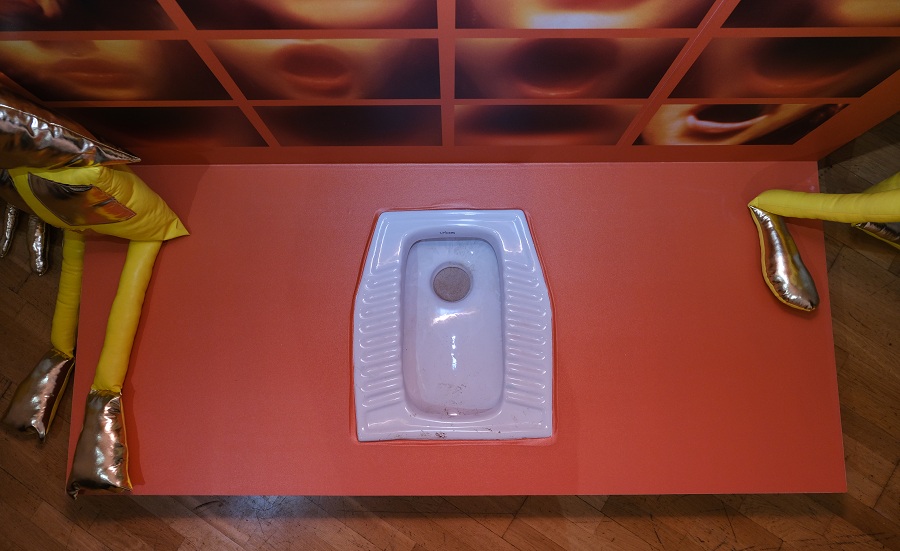
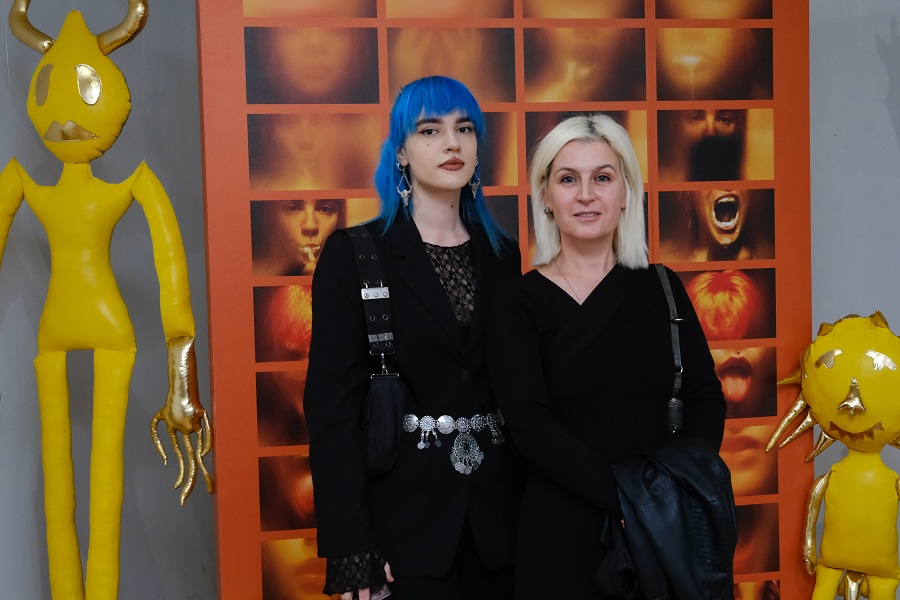
The Yellow Turn rises as a wall-monument (lapidar), evoking a temple where we confront the endless cycle of cleansing and defilement, an infinite rotation without beginning or end, reflecting body, mind, and spirit. At its base, an opening for drainage anchors the installation to the ground, while a grid of toothbrushing photographs turns an ordinary gesture into a ritual act, shifting daily routine into meditation.
Yellow is not merely a color, but a state, at once light and stain, promise of purity and trace of impurity. Around the wall stand hand-sewn fabric figures, fragile bodies as soft as the material itself, born of fantasy, childhood traces, and intimate states. They are fragments of the self, echoes of memory, naive conscious beings who, in their stillness, carry both innocence and unease, silent witnesses in public, yet always unquiet in my mind.
Visitors are confronted with an act elevated to monumental scale, underscoring its weight in everyday life, while remaining free to experience the softness and elasticity of the surrounding creatures. In this suspended quietude, where intimacy merges with the collective and the body remains exposed, observed, and transformed.
About the artists
Enza Rripaj (1995, Shkodër, Albania) is a visual artist based in Tirana. She studied Painting and Graphics at Luigj Gurakuqi University in Shkodër and later pursued a Master’s degree in Multimedia at the University of Arts Tirana. She was a full-time student for four months at the Siena Art Institute and participated in the alternative educational program Curating with Care by Tirana Art Lab.
Her work has been presented in group exhibitions: T.I.V.A. Tiranë (2024); Gjon Mili I.V.A. Festival, Korçë (2024); Performative Exhibition #4 – Written Cave, GAD Korçë (2024); “Gur”, Petrelë (2024); Last semester’s final exhibition at Siena Art Institute (2019); “Shkodra remembers”, Site of Witness and Memory, Shkodër (2016).
Olsi Hoxha (1990, Tirana, Albania) is a filmmaker and multimedia artist based in Tirana. He studied at the Academy of Arts in Tirana (BA & MA). His work spans video, sound installations, and electroacoustic objects, often using obsolete technology and found materials. He is the founder of Radioblog Tirana and Nepotik, a platform for independent art and publishing.
Dea Shubleka (1998, Peshkopi, Albania) is a multidisciplinary visual artist who lives and works in Tirana. She graduated with an MSc in Applied Design at Polis University (2023) and a BA in Painting at the University of Arts, Tirana (2020). Her practice spans painting, photography, cyanotype, installations, doll-making, and voice performance, exploring identity, memory, and emotional states through intuitive and multimedia forms.
Her selected exhibitions include: Perspectives that Transcend: Visual Resonances from Albania, Sala Golfes, Barcelona (2025); Point of View, Vienna Contemporary Art Space, Vienna (2025); tipping point, Ausstellungsraum Eulengasse, Frankfurt (2024); Inner Space, Gallery70, Tirana (2024); PARAROJA Zine Launch, Bulevard Art Media Institute, Tirana (2024); National Exhibition “Salloni i vjeshtës”, Shkodër (2023); Fashioration, Erasmus Project, Sarajevo (2023); ESCAPE, FAB Gallery, Tirana (2020).
Bekim Hasaj (B. Curri, Albania, 1990) holds a BFA from the Brera Academy in Milan, Italy. Since 2017, he has lived in Ostrobothnia, Finland, where he co-founded Black Box Genesis® with his artist partner, Valentina Gelain. He was awarded the Frans Henriksson grant from Svenska Kulturfonden for 2025-2026, and was shortlisted in numerous art contests between Italy and Albania.
A selection of exhibitions and pubblications include: ‘The Shell Cracked’, Gallery 3H+K (Pori, Finland, 2025); The book ‘222 Artisti emergenti su cui investire / 2024’, publisher – Exibart (Rome, Italy); Yö Fest vol.4, Yö Galleria (Helsinki, Finland, 2024), ‘Dripping Cavities’, Vaasa City Art Gallery (Finland, 2024); VIZart, National Historical Museum & COD (Tirana, Albania, 2022); Helsinki Urban Art (Helsinki, Finland, 2022).
About the jury
Lindsey Berfond is an Assistant Curator and Studio Program Manager at the Queens Museum, where she has supported, co-organized, or curated the presentation of over 15 exhibitions, including large-scale solo exhibitions, group shows, and several QM-Jerome Foundation Fellowship exhibitions. She also works on residencies, special projects, and public programming at the Museum with artists, cultural producers, and communities. Lindsey earned her BA degree in Art History from New York University and her MA degree from the Center for Curatorial Studies, Bard College. She has contributed to exhibitions and other programming at institutions such as Art in General, NURTUREart, and SculptureCenter.
Alban Hajdinaj studied graphics at the Academy of Arts in Tirana, Albania. Worked as a researcher at the National Gallery of Arts in Tirana, Albania. His works have been exhibited at Ludwig Museum of Contemporary Art (Budapest); Centre Georges Pompidou (Paris); International Studio & Curatorial Program (New York); Mart, Museum of Modern and Contemporary Art (Trento and Rovereto); Haus der Kulturen der Welt (Berlin); 52nd Venice Biennale (Albanian Pavilion); Chelsea Art Museum (New York); Moderna Galerija (Ljubljana); National Gallery of Kosovo; National Gallery of Arts (Tirana); Sammlung Essl, Klosterneuburg (Viena); Manifesta 4” (Frankfurt/Mein); IFA Gallery (Berlin /Bon) and Tirana Biennale 1.
Hajdinaj’s works are also part of public collections such as: Musée National d’Art Moderne (Centre George Pompidou), Paris; Ludwig Museum of Contemporary Art, Budapest; Peter und Irene Ludwig Foundation; National Gallery of Arts, Tirana; FMAC Paris; Zabludowicz Collection, London; Kadist Foundation, Paris.
Francesco Scasciamacchia is a curator and researcher working at the intersection of contemporary art, critical studies, and performance. He obtained his PhD in Drama from Queen Mary University in London (2015) and participated as a Critical Studies Fellow in the Independent Study Program at the Whitney Museum of American Art in New York (2013-2014). Previously, he was an Assistant Professor at Universidad de las Americas in Puebla, Mexico, and has worked as curator and cultural organizer in different institutions such as Jumex Museum, Mexico City; Arnaldo Pomodoro Foundation, Milan; Viafarini, Milan; and was a regular contributor in art magazines such as Flash Art and Mousse.
He is the co-founder of the not-for-profit art organization Cijaru, working on contemporary art, locality, and craftsmanship in his own region, Puglia, in Italy. He is also an editorial member of Art Studies, the academic journal of the Academy of Science in Tirana. Currently, he is a lecturer in the Department of Art and Design at Polis University.